
Dr. Brian Boyd Reflects on Visit to Rayburn Correctional Center
Hope, Love, and Financial Literacy at Rayburn Correctional Center


“We thank you, Father God, for this day which we have never lived before, a new opportunity to learn.” As Pastor Chris continued his extemporaneous opening prayer before his dozens of congregants, I could not but marvel at his words in this setting. The chapel was simple, with round tables and folding chairs arranged before an altar, drum set, and suspended cross; just outside were carefully tended rose bushes and a new granite monument with the Ten Commandments carved in the stone, and at the bottom, Christ’s Great Commandment (Luke 10:27). I was there with colleagues and students from Loyola and a representative of Resilience Education, but most of those present were men with their heads bowed in prayer, or at least quiet respect, who are finishing out their prison terms in B.B. ‘Sixty’ Rayburn Correctional Center. Pastor Chris, who is credentialed as a Baptist preacher through extension school, commanded the room not only because of his intense earnestness and powerful physical presence, but also because he was there every day, in their shoes.
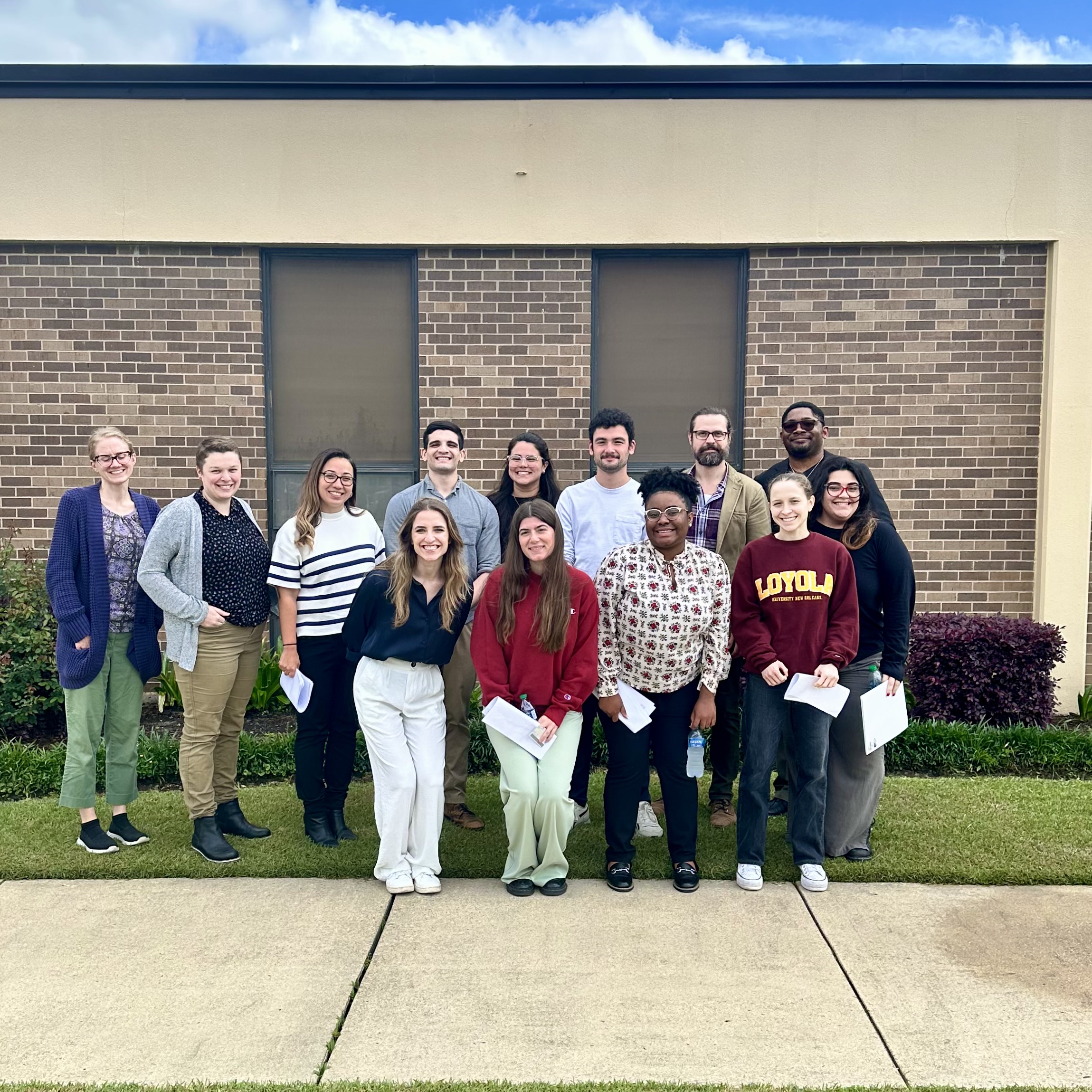
Thanks to the prison education program which the Jesuit Social Research Institute (JSRI) has developed with Rayburn, this past spring my colleagues and I at Loyno’s Center for Ethics and Economic Justice had the opportunity to bring two groups of undergraduate Ethics Fellows to provide financial literacy classes. Though held in the chapel and bookended with prayer, we offered straightforward instruction in personal finance, teaching fundamental topics in budgeting, investing, borrowing, and shopping around for a deal. Our audience was the “reentry class” at Rayburn – incarcerated men nearing the end of their sentence who take workshops on how to readjust to life outside. After each class we were honored to share a meal with the leaders, both essential staff like Melissa Mohon as well as incarcerated men like Pastor Chris and Bobby Ray, who runs the Catholic Bible study group. Bobby Ray told me that “what you have given us is hope that we can get out and do something for ourselves.” He emphasized the link between poverty and recidivism, the need for not so much a second chance as a fair chance at success, saying “It’s hard to see someone leave here and come back.”
Beyond the knowledge, skills, and contact information to service providers we offered, a key component was the Socratic style of instruction, modeled for us by the prison education nonprofit Resilience Education. Even though we had about seventy students in the chapel, rather than a straight lecture format, our Ethics Fellows used a question-and-answer form of pedagogy to draw out knowledge from the room, demonstrating - as Socrates did in Plato’s dialogues - that careful questions can not only humble the proud but also uplift and encourage the humble.
It was powerful to see how quickly the room opened up, joking and laughing even while listening closely and taking good notes. As Loyola main campus student Matt Modisette reflected afterwards, “It was so heartening to, apart from the course material, provide a space to give the students a chance to tell their story and to be heard.” For example, although compound interest is often praised as “the eighth wonder of the world,” a mathematical miracle, one of our Rayburn students suggested it might be better to call compound interest “the most evil invention.” This makes sense if you have only ever been a debtor with compounding payday loans rather than an investor with a mushrooming 401k. The relatable need to avoid bad loans like quicksand and stick to a budget led to frank talk and memorable stories.
St. Ignatius writes in the Spiritual Exercises that “love consists in a mutual sharing of goods,” goods which include spiritual possessions like knowledge. This is part of our mission at Loyola University New Orleans in preparing students “to lead meaningful lives with and for others.” On our first visit to Rayburn, the granite block with the Ten Commandments and the Great Commandment looked as though it had been recently installed. On our second visit, two incarcerated artists were kneeling before it, and with extreme precision and care, using gold-flecked paint to fill in the letters and make them glow in the springtime sun. As we were leaving – with plans to return each semester – one man had just finished illuminating the first three words in Christ’s command: YOU SHALL LOVE.
Brian J. A. Boyd, Ph.D., is the Research Assistant Director of the Center for Ethics and Economic Justice. This is his first year at Loyola University New Orleans, where he teaches business ethics, writes on economics and Catholic Social Teaching, and helps organize the CEEJ’s service to Loyola and the broader community, with an emphasis on financial literacy and wellness. Contact him at bjboyd@loyno.edu.